


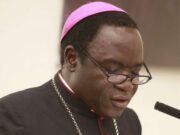

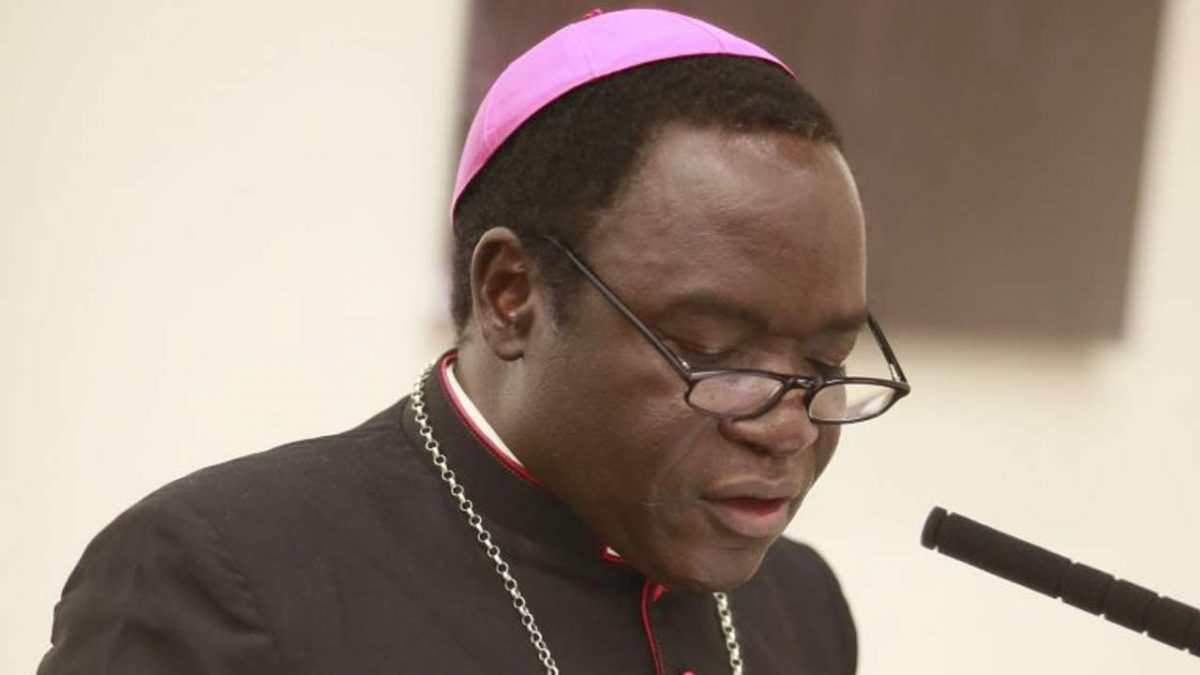
Catholic Bishop of Sokoto, Matthew Hassan Kukah, has accused state governors across Nigeria of abusing their constitutional powers over land to dispossess communities, deepen environmental degradation, and undermine social justice, warning that such practices threaten peace, moral authority, and national cohesion.
He spoke in Lagos on Friday while delivering the 24TH Chief S.L. Edu Memorial Lecture organised by the Nigerian Conservation Foundation (NCF) with the theme, “To Have and To Hold: Faith and Care of the Environment.”
The lecture was in memory of Late Chief Shafi Lawal Edu, renowned businessman, environmentalist and conservationist.
Speaking on faith, governance and environmental justice, Kukah said the Land Use Act, originally designed to hold land in trust for the common good of Nigerians, has instead become a tool for arbitrary acquisition and displacement, often benefiting political elites and private interests at the expense of ordinary citizens.
He lamented that despite all efforts of the government, Nigerians are not doing well in caring for the environment.
According to him, the excessive concentration of land control in the hands of governors has weakened traditional land systems, marginalised smallholder farmers and left communities powerless when their ancestral lands are taken without consultation or adequate compensation.
He said, “The Land Use Act which has placed all responsibilities for land in the hands of State governors is a grave mistake. This has produced many distortions and blurred the lines of duty and responsibilities between the states, communities and the federal government over land and mineral resources.
“Governors have taken their power over land as a license and as such, displacement of communities by land acquisition, often for cronies or businessmen and women, generates community conflicts where ordinary people feel totally powerless.
“The Act, intended to unify diverse customary land systems, instead created a system where land access depends heavily on bureaucratic approval rather than traditional occupancy, often marginalising the poorest land users.”
“The land was not given to us to plunder,” Kukah said, stressing that power over land carries a moral obligation. “To till and to keep, to use and to preserve, are inseparable responsibilities,” he said.
He warned that the misuse of land authority has contributed significantly to communal conflicts across the country, noting that many disputes described as ethnic clashes, farmer-herder conflicts or communal violence are rooted in deeper ecological and land injustices.
Kukah said environmental destruction in Nigeria is often driven by profit without conscience, where forests are cleared faster than they can regenerate, rivers are polluted in the name of extraction, and degraded land is abandoned without restitution.
“Environmental destruction does not occur in isolation. It erodes trust, legitimacy, and social cohesion among peoples. When communities watch their lands taken, their waters polluted, and their futures mortgaged without consent or compensation, grievances accumulate and wait for a trigger.
“These grievances are often misnamed herder-farmer clashes, ethnic conflict, cattle rustling, religious violence and communal tension, but at their core lies a deeper wound: ecological injustice. A state that cannot protect its land cannot protect its people. When ecological funds are diverted, when environmental impact assessments are treated as formalities, when regulatory institutions are weakened or politicized, the state forfeits moral authority. When state laws and rules lose their meaning and resonance, citizens disengage and survival replaces solidarity. We then have cases of diffusion of circles of violence of one against all and all against one.”
Citing the Niger Delta experience, the cleric recalled years of environmental damage caused by oil exploration, which left communities impoverished despite vast resource wealth. He noted that extraction without restoration and profit without justice have become defining features of resource governance in many parts of Africa.
He also criticised a culture that treats land and natural resources merely as commodities, warning that such an approach erodes trust in government and fuels instability.
“When communities watch their lands taken and their waters polluted without consent, grievances accumulate,” Kukah said, adding that a state that cannot protect its land cannot protect its people.
Kukah called on religious leaders to speak out more forcefully against environmental exploitation, saying faith institutions must provide moral clarity where political systems fail. He said stewardship of land is a sacred trust and not an absolute right.
He urged government at all levels to rethink land administration policies, strengthen environmental regulation and ensure that communities are not excluded from decisions affecting their livelihoods.
According to him, caring for the environment is inseparable from promoting peace and justice, warning that neglecting ecological responsibility would continue to breed conflict, poverty and insecurity.
He called for a return to moderation, justice and accountability in public life, stressing that Nigeria’s future depends on how responsibly its leaders manage land and natural resources entrusted to them.
Chairman, National Executive Council (NEC) of NCF, Justice Bukola Adebiyi said with increasing threats to nature — deforestation, pollution, climate change, and other unsustainable human activities — “the foundation of our very existence is under pressure.”
“Considering that many of us are people of faith — Christians, Muslims, Hindus, Buddhists, and adherents of traditional religions — some even practicing more than one — this lecture serves as a vital reminder that conservation is not solely the responsibility of governments or organizations like NCF. It is a shared duty.
“It calls for collective action from each of us to adopt practices that protect and preserve our natural environment and heritage for present and future generations — a responsibility for which we are accountable to the Almighty, from whom we received the gift of the Earth,” she said.
With 75m-litre daily PMS output, Dangote Insists it can meet domestic consumption
Dangote Petroleum Refinery has reaffirmed that it has sufficient capacity to meet Nigeria’s domestic demand for Premium Motor Spirit (PMS), insisting that its daily production of 75 million litres comfortably exceeds estimated national consumption.
In a statement, the refinery stated that Nigeria’s daily PMS consumption is estimated at about 50 million litres, leaving a significant supply buffer that can absorb demand surges, reduce the need for fuel imports and stabilise the downstream market.
Beyond petrol, the refinery said it can also supply 25 million litres of Automotive Gas Oil (AGO) daily, compared with an estimated national demand of 14 million litres, as well as 20 million litres of aviation fuel per day, far above the country’s estimated maximum daily consumption of four million litres.
According to Dangote Refinery, the ability to supply volumes above prevailing demand provides critical market resilience, particularly during periods of peak consumption or logistical disruptions, while strengthening Nigeria’s energy security.
“The management of Dangote Petroleum Refinery reiterates our capacity to supply petroleum products of the highest international quality standards to marketers and stakeholders,” the company said.
“Our current capacity includes 75 million litres of PMS, 25 million litres of AGO and 20 million litres of aviation fuel daily,” it added.
Industry analysts say sustained domestic supply at these levels would significantly reduce Nigeria’s dependence on imported refined products, cut foreign exchange exposure and improve pricing stability in the downstream sector.
They also note that surplus supply strengthens inventory cover and reduces the risk of emergency imports, which have historically strained foreign exchange reserves and disrupted local pricing.
Dangote Petroleum Refinery reaffirmed its commitment to regulatory compliance, stating that it continues to work closely with the Nigerian Midstream and Downstream Petroleum Regulatory Authority (NMDPRA) to ensure alignment with market rules and supply-stability objectives.
The refinery said it remains engaged with regulators and industry stakeholders as Nigeria deepens its transition from fuel importation to domestic refining, adding that it is working to ensure consistent supply, competitive pricing and improved market discipline nationwide.
With domestic refining capacity expanding, stakeholders believe Nigeria is increasingly positioned to achieve supply security, strengthen downstream efficiency and reduce exposure to external supply shocks through locally refined petroleum products.